


According to a French journalist Danny Boyle himself encountered on a press tour, he is a director who makes the same films over and over again, just looking slightly different – always following a young man (at this point apparently she rolled her eyes) always overcoming impossible obstacles. And Danny Boyle apparently couldn’t agree more, claiming that “you do remake the same film again and again and you try to disguise it and genre helps.” And it’s true, he’s a director of such a calibre that it’s hard to pinpoint his particular style. He is not a genre filmmaker nor does he have a distinctive visual aesthetic, yet all of his work is grounded, depicts the complexity of human nature and challenges the limits of morality in different settings whether it’s in a poor neighbourhood in Edinburgh or on a stranded beach.
With over 30 years of experience behind his back, it’s no wonder that it was time for Danny Boyle to take home the ultimate award for lifelong achievement and no, it is not an Oscar. He already has one. It is, in fact, the prestigious James Joyce Award, given by the Literary and Historical Society (L&H) of University College Dublin (UCD). Named after James Joyce who was himself a UCD alumni (then University College), the award is annually given to people from fields as varied as its previous recipients. Actor Ralph Fiennes and writer Seamus Heaney are among some of them.
So, on June 20th, the award ceremony took place on the premises of the UCD campus in their own cinema with a screening of 28 Years Later, followed by a Q+A with Boyle himself, hosted by Noah Mullen Clarke, auditor of the L&H Society. Naturally, me and my stomach bug, which is what I told my manager earlier that morning when I called in sick (shh, don’t rat me out!), headed to my old campus to see the much anticipated sequel and be in the presence of someone who has worked with at least one of every 2010’s teenage girls’ crushes (I’m looking at you Aaron Taylor-Johnson and Dev Patel).
The UCD Cinema happened to be a solid venue for the event despite its smaller scale, since its coziness added to the intimacy of the whole experience. It never felt as if the audience was a bystander as our proximity to the stage made the Q+A almost interactive as Boyle often addressed the public and cracked jokes as if he was himself surprised how casual it all felt. It was hard for me to imagine that this man who was sitting only two rows away from me and was speaking so nonchalantly had once been in the Dolby theatre accepting the prestigious Best Director award in front of thousands of people. Boyle also appeared to be very approachable as at the end as we were all standing there, waiting for him to be escorted out. However, he simply stood up, stared at us and jokingly asked if we were going to stay there all day without moving. After that, he merged into the crowd of the suddenly rising from their chairs enthusiasts who, given the ‘green light’, were now lining up asking for a photo or an autograph. There were posters of Trainspotting being waved, copies of Garland’s The Beach being tossed around and markers flying everywhere, but Boyle and his team seemed to be obliging and patient despite being pressed with time as there was another Q+A being held at the IFI later that day. But I’m getting ahead of myself.
Let’s not forget that before we even got acquainted with mister Boyle (I had the urge to write “Sir”, but after a quick check on the internet, I figured out he was offered a knighthood for his work on the opening of the London Olympic Games back in 2012 that he ultimately refused, stating believing “in being an equal citizen rather than a preferred subject”, so take that, “Sir” Christopher Nolan), we had the chance to see 28 Years Later.
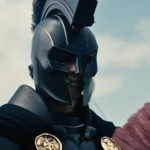
28 Years Later is what every legacy sequel should strive to be. It pays homage to its source in a delicate way, but still manages to stand on its own feet. Unlike most franchises, especially horror ones, 28 Years Later doesn’t dwell too much on nostalgia and doesn’t rely on the audience’s connection to it. Instead, it focuses on worldbuilding and tells a simple, yet heartfelt story that most definitely would bring a tear to your eye. Boyle returns in the director’s chair, but so does Garland with the ink. This marks their first collaboration since 28 Days Later and you can tell they have an established working dynamic. They’ve also brought on board the original cinematographer Anthony Dod Mantle and here’s where this film truly shines. Similar to 28 Days Later which was shot on a camcorder, contributing to that raw, gritty bleakness of the film, the new installment in the franchise is a technical achievement on its own. Shot on iPhone 15 as well as GoPros and multiple types of drones, Boyle does what he does best- experimenting, just like back in 2002. We have to agree that even if a film is not your cup of tea, if it actually tests the limits of the format, it has done its job since challenging the ways of the contemporary visual medium is where the essence of cinema truly lies. Some of the shots are bold and unrefined, almost feeling animalistic such as the infrared/thermal camera nighttime scenes. Others feel almost sloppy such as the close-up ones of characters running or shooting. During the Q+A, Boyle actually specified how useful indoor small drones could be since they can “bang into people without hurting them”, resulting in better and more realistic impact shots. “Technology is like a tool…like a pencil! You just have to use it.” This is where he briefly touched on the AI discourse as well as he added it to the list of tools to be used, yet he didn’t elaborate on it further.
Another brilliant aspect of the film is the sound mixing and the soundtrack which is the work of Scottish hip-hop group Young Fathers. It enriches the unsettling ambiance at the start and leans more on the sentiments by the end. The acting is worth mentioning as well, especially in the face of newcomer Alfie Williams who carries the film with his sincerity. His father-son dynamic with Aaron Taylor-Johnson in the first act is energising and layered, but it’s Jodie Comer who is the emotional driving force of the film. She portrays the ineluctability in her character’s fate and her inner fear and disappointment of life’s unfairness with such tenderness. Boyle adds that both Comer and Taylor-Johnson had their influence on Alfie Willaims whether it was the latter making him do push-ups before a scene as preparation or Comer who focused on the more “intangible” part of acting and rather the one that truly stays with you. Speaking of acting, my personal favourite has to be Edvin Ryding who might be familiar to some from the Swedish show Young Royals. It might be Ryding’s first full English-speaking role, yet he nails the few minutes of screentime he has with his impeccable comedic timing.
It’s never revealed if 28 Years Later fully dismissed everything that the unofficial sequel 28 Weeks Later establishes, but in its setting of the entire mainland of Britain being completely isolated from Europe and put under permanent quarantine, it certainly hints at a commentary on Brexit. On the question how conscious is the political messaging when directing a film, Boyle insists it’s “usually unconscious, but because you’re alive and you’re living through the politics of the day, it bleeds in.” He also talks of the versatility of the horror genre that often allows you to “put transparencies of issues flow across it…a bit of Brexit in it, COVID and the horrors around the world.” He even shouted out Romero, often considered the founder of the zombie genre, who often used his movies to comment on class, race and more.
The film definitely further proves that Alex Garland is at his strongest when someone else directs his projects. The first act of the film has a rich world-building that is undoubtedly strongly influenced by recent additions to the genre such as The Last of Us which even further adds to the discussion of how art truly circulates. In fact, earlier this year Neil Druckmann – the creator of The Last of Us – was in conversation with Alex Garland and confirmed a major inspiration for the game was 28 Days Later to which Garland responded that the game made him realise how much more unexplored potential there was in his own creation and how much the second Last of Us game served as a major influence on writing the new sequel. The kid in the woods with a father figure, the isolated community that’s accustomed to the violent world around them, it’s a slippery slope, but Garland is steady on his skis. The script feels so fresh and despite the seeming simplicity of the story, it touches on an interesting question that Boyle summarizes very well which is “if technology vanishes, do we continue to progress and evolve as people and as society.” Garland has looked into an almost terrifying outcome of events of going backwards to the roots by reinforcing gender stereotypes and in this case, glorifying cultural myths of England. Here, Boyle decided to flip us all off in his attempt to explain the origins of the gesture, dating back to the 15th century. Anyways, Garland pays homage to his own creation by not falling into the trap of a tired zombie narrative, but rather exploring grief, the impermanence of life and societal response to isolation. The divisive ending also explores an intriguing concept of how much the media kids consume actually has an impact on them.
About frequently collaborating with John Hodge and Garland, Boyle gives advice to young scriptwriters that if they want to attract a visually interesting director, they need to write sparingly and get rid of heavy descriptions that take away the freedom of the director. “A novelist is a film director, they’re doing everything, but a screenwriter is setting up potential for the director to then investigate.”
As for his advice for young filmmakers in general, Boyle says that “it’s crucial not to pay too much attention to people like me, because I’m older and cinema is a vampire for young ideas.” He explains it’s young people that go to the cinema and people his age are practically useless and you shouldn’t listen to the “masters”, but only to your peer group and basically do what you want. He jokingly says that being outrageous is the key to the industry and that there isn’t anything wrong with wanting to do Jane Austen adaptations, but the “appetite” is for new ideas. As much as this was inspiring, I believe all of us in the room as young aspiring people in this field, aware of the current state of the film industry, we were probably collectively thinking (at least I was) how if this was true it wouldn’t contradict as much with his later statement of how in order to get funding for this new trilogy, they had to reassure the producers Cillian Murphy was going to appear, even briefly, at the end of the second one. It’s a motivational and touching thought, but it doesn’t seem to be resonating with the actual film market that craves IPs that can secure a solid box office and result in endless merch. However, 28 Years Later’s success is certainly a step in the right direction and would hopefully restore the studios’ fate in the viewers.
Speaking of aspiring filmmakers Boyle himself was such once too and apparently what made him want to be a director was not even a film, but something rather simple like seeing the poster for Apocalypse Now. He also added that even though he was raised in Manchester by Irish parents, he took the cultural heritage for granted and only fully emerged himself while working on Elephant in Northern Ireland during the Troubles.
After briefly talking about his experience in Mumbai shooting Slumdog Millionaire and directing the Olympic Games, it was evident that Danny Boyle has done everything – TV, film, stage (a brilliant adaptation of Frankenstein), so what was next? Possibly his biggest dream – directing a musical. He, then, expressed his admiration for Emilia Perez that was met with a loud giggle from the audience that grew into an uncomfortable and muffled laugh once we found out he was being serious and not sarcastic. At that point the questions of our competent host were at their very end and so was the given time, so Danny Boyle giddily asked if the questions had simply run out.
The Q+A was wrapped officially with a confirmation of 28 Years Later: The Bone Temple which according to Boyle and Garland, unlike this one, exploring “the nature of family”, will be about “the nature of evil” and which will allegedly be released 28 weeks from now.

