
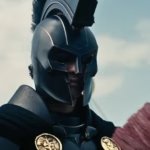


Christopher Nolan’s adaptation of The Odyssey is the most highly anticipated cinematic event of the year. It seems to have piqued the interest of everyone in my life. I have seen The Odyssey in cinema twice already. As I write this, I am arranging to go a third time. The film, based on Homers ‘The Odyssey’, follows Odysseus, played by Matt Damon, on his journey home after winning the Trojan War. Matt Damon carried every emotional beat of this film flawlessly. His presence on screen is so assured that you understand why these men follow his command and trust his leadership. Until of course, they don’t anymore. I was able to see this film in 70mm at the IFI, and on a large screen at the Omniplex in Cork. While the IMAX 70mm version is not available in Ireland, I felt the scale of the film was still conveyed at both of my screenings. I understand why Nolan wanted this film to be the first production to be filmed entirely on IMAX cameras. Watching Odysseus’ men sail across the vast open ocean, made me realise just how big the world would have felt to them, when they did not know what they might find at each shore. Nolan repeatedly uses large empty landscapes to remind the audience just how hard this journey would be. He also uses large set pieces, the Trojan horse which must be dragged from the beach to the gates of Troy by hundreds of men, the gates themselves which require several men to finally push them open, and large towers and buildings within Troy which are sent crashing down around Odysseus, to remind us of the scale of the betrayal he orchestrated and the destruction he caused.
One of the most exciting things about The Odyssey is the commitment to practical effects. The cyclops Polyphemus, perhaps one of the most iconic creatures from the original tale, is not CGI, but an animatronic puppet voiced by actor and puppeteer Bill Irwin. In a later sequence the witch Circe, turns Odysseus’ men into pigs, in true body horror fashion. The way she grabs at and moulds their faces, forcing her hand down their throats, pulling at their skin until their eyes bulge was so repulsive I wanted to look away but I couldn’t pull my eyes from the screen. I later discovered this scene was also not achieved through CGI, but through animatronics. When the soldiers leave Circe’s island they travel to Hades to hear a prophecy from one of their fallen soldiers. This scene, shot on a black sand beach in Iceland, features men crawling out of the ground, as if emerging from the underworld. This too was done practically. Trained stunt men were buried under the sand with snorkels allowing them to breathe.
Nolan’s commitment to practical filmmaking is not just a refreshing stance in an industry eager to offload creative work to AI, its proof that filmmaking at this scale, which creates hundreds of jobs, is still possible and profitable without sacrificing artistry. Some people have criticised this adaptation for sanitising the original story, to make it more ‘Hollywood’ appropriate. And yes, some parts are changed to make Odysseus a more sympathetic hero. He does not sleep with Circe, and while it’s implied we do not see his romantic relationship with the demigod Calypso play out on screen. Instead, we see him remain completely loyal to his wife Penelope, played by Anne Hathaway, who gives one of the best performances I have seen from her in years. Despite the dozens of suitors who gather at her home to feast and wait for her to choose a new husband, she remains steadfast in her decision to wait for Odysseus to return home. Not because she does not know what to do without him, but because she loves him, and knows that his return is the only way she will be allowed to remain in her home and live the life of her choosing. I found this incredibly refreshing for a Nolan movie, as in the past his female characters have left a lot to be desired. Hathaway, like Damon, is able to go big when she needs to, but she also creates beautiful intimate moments with Odysseus, and with her son Telemachus, played by Tom Holland.
Tom Holland’s performance surprised me the most and I found him really enjoyable to watch. He does not have the presence of Damon, or Hathaway, who have many years of experience over him, but he plays Telemachus with genuine youthful naiveté, hopefulness, and fear. His performance has received some criticism, but I found him charming and sympathetic. In fact, despite the beautiful landscapes, otherworldly set pieces, and heart racing action sequences, the most memorable part of this film for me is much smaller. Fearing that he will not be welcomed home with open arms after all he has done, when Odysseus does reach Ithaca he disguises himself as a beggar. Despite his best attempts he is recognised by his old hunting dog, and his identity is revealed to his son. Holland and Damon are both incredibly understated in this scene, and while I expect Damon to be able to carry this kind of emotional depth, Tom Holland’s performance here is such a joy to watch. If I had any doubts about his ability up until this point they were dispelled, and I shed a little tear.
In my opinion, Nolan does an incredible job at bringing the story into the 21st century. We still experience the mythological world of ancient Greece, with all its monsters, magic, and mysticism. However, Nolan’s adaptation focuses more on the guilt that follows Odysseus, how it shapes his view of his victory in Troy, and how it guides his journey home. More than an epic tale of monsters and God’s, Nolan’s Odyssey is a story of repercussions and responsibility. Odysseus must face those who paid for his actions, whether his actions were well intentioned or not. I found this adaptation to be surprisingly optimistic. In a time of increasing social uncertainty, Nolan says we must pay for the hurt we cause each other, and that those who break the trust between people must face consequences. Odysseus returns home, but nothing can be as it was before he left. As he leaves Ithaca in exile, and Telemachus remains to take the throne, Nolan reminds us that even after the darkest age, civilisation will rise again. I couldn’t help but think about how Nolan’s children worked on this film alongside him, and how his relationship with his children might shape his view of the future. The Odyssey could have ended on a very bleak note, with peoples trust in each other broken and civilisation on the brink of collapse, but Nolan has hope for the future and the world he will leave his children.

